The short answer
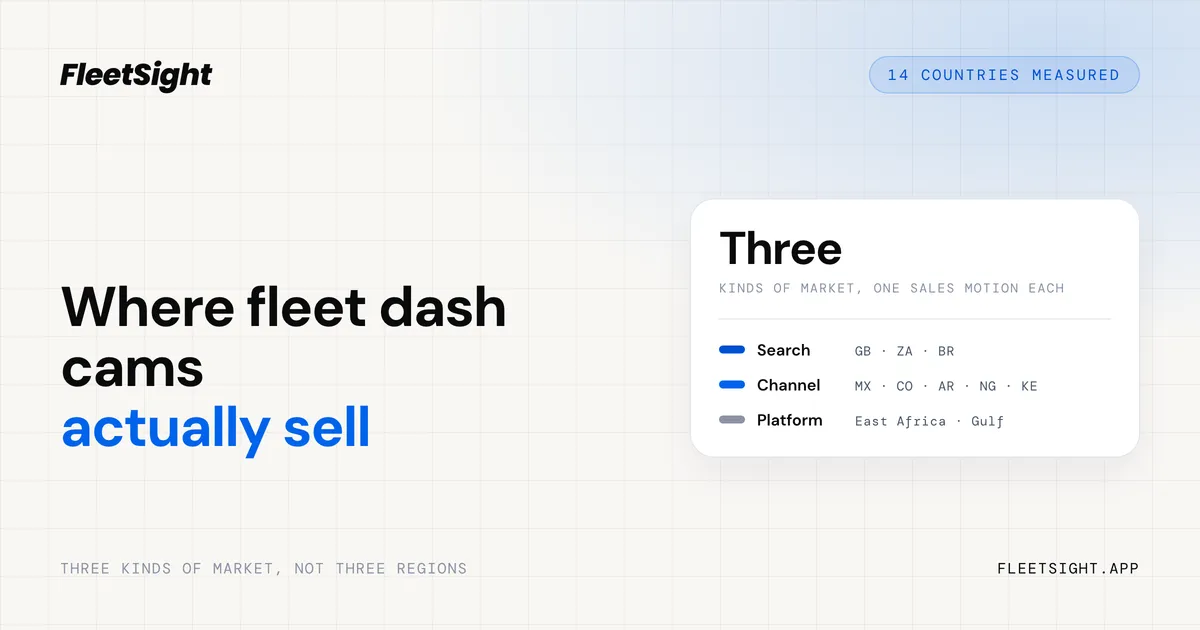
Fourteen countries, three kinds of market, not three regions. Search markets — Britain, South Africa, Brazil — where pages earn their keep. Channel markets — Mexico, Nigeria, Kenya — where the B2B words are unsearched and distribution is the way in. Platform markets — East Africa and the Gulf — where the demand is for a system and the camera rides in on it.
Fleet video is usually discussed as a European product with some export upside. We measured search demand across 14 countries in September 2026 and that framing does not survive contact with the data. What the numbers show is not three regions but three kinds of market, and each one needs a different sales motion.
| Market type | Where | The word they type | Score | How you sell into it |
|---|---|---|---|---|
| Search | Britain | dash cam installation | 56.4 | Pages about fitting, price and the day itself |
| Search | South Africa | dash cam | 37.6 | Pages — and the tracking incumbents as customers |
| Search | Brazil | câmera veicular | 67.8 | Pages in Portuguese; ANATEL already held |
| Channel | Mexico | DVR móvil | 0.3 | A price list and stock, to named distributors |
| Channel | Nigeria | fleet management | 8.6 | Phone calls and marketplaces |
| Platform | Tanzania, Uganda | wialon | above both tracking terms | Compatibility first, catalogue second |
| Platform | UAE | fleet management | 23.3 | Through the local recorder suppliers |
Scores are shares inside their own comparison, not volumes — the rest of this post is what each row means.
Type one: the search markets
Britain, South Africa, Brazil. People type the category into Google, the tail has money in it, and pages earn their keep.
In Britain, “dash cam installation” scores 56.4 against 0.7 for “video telematics”, and “dash cam installation cost” is up 300 % in a year. Rising alongside it: “commercial vehicle tracking systems” and “fleet vehicle tracking devices” (both breakout), “vehicle tracking software” +110 %, “fleet management platform” +450 %. The page that wins there is about fitting, price and what happens on the day, not about the technology.
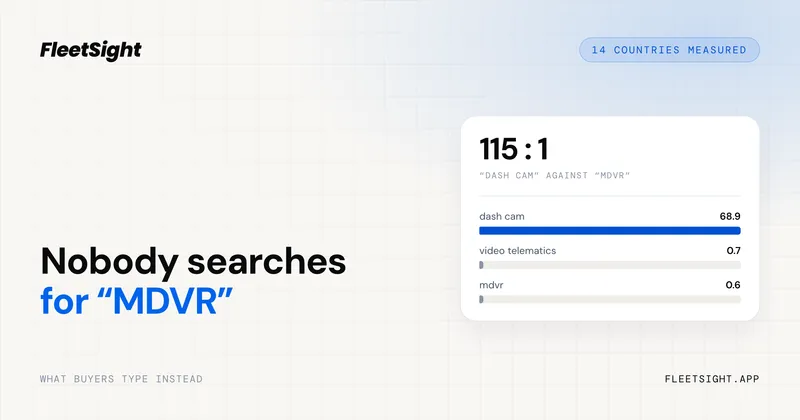
South Africa is the same shape at lower cost of entry: “dash cam” 37.6, “telematics” 22.8, “fleet management” 19.4. The tail is commercial — “dash cam south africa”, “dash cam price” (+150 %), and over five years “ai dash cam” up 800 %. The search results are owned by the local tracking giants: Tracker, Netstar, Cartrack, MiX Telematics. Those companies are simultaneously our competitors and our best possible customers — they sell subscriptions and they buy cameras. Meanwhile “mdvr supplier south africa” returns spy shops and Chinese factories selling direct, with nobody in between offering a platform and a warranty.
Brazil is the only Latin American market with real search demand, and it is substantial: “câmera veicular” 67.8, “rastreamento veicular” 64.7, “gestão de frota” 17.9. Inside the tracking tail sits “plataforma de rastreamento veicular” and, explicitly, “aluguel de plataforma de rastreamento” — renting a platform is an established purchase there, not an idea we would have to explain. Hardware search is dominated by one brand, Intelbras, which is why we wrote the comparison. Brazil is also the one market where our certification is already in order: BSJ carries ANATEL.
Type two: the channel markets
Mexico, Colombia, Argentina, Nigeria, Kenya. The B2B words are effectively unsearched; the buying happens through companies.
Mexico is the clean example. “Rastreo vehicular” 2.3, “DVR móvil” 0.3, “gps para flotillas” 0.0 — against 71.3 for consumer “dashcam”. But the results page for “dvr movil” is a complete map of the distribution channel: Syscom, TVC, Cyberpuerta, QDigital, Simple y Directo, Mercado Libre. That is where the product moves, and the way in is a price list and stock, not a blog post.
Nigeria looks similar with less depth: “fleet management” is the biggest term at 8.6 and its tail is informational (“what is fleet management”, plus graduate-trainee vacancies). Search results belong to cartracker.com.ng, autotracker.com.ng and MTN; the cameras themselves sell on Jiji, Jumia and Konga. It is a market of phone calls and marketplaces.
Type three: the platform markets
East Africa and the Gulf. Here the demand is for a system, and the camera rides in on it.
The finding that surprised us: in Tanzania and Uganda, “wialon” is searched more than “vehicle tracking” or “fleet management”. Worldwide, interest in the term concentrates in Rwanda (100), Tanzania (90), Sierra Leone (65), Uganda (64), Guinea (55), Kenya (45) and Côte d’Ivoire (33), with a CIS tail through Moldova, Armenia, Georgia and Kazakhstan. Nobody there searches for dash cams at all — the score is 0.0. So the buyer is an existing Wialon operator running somebody’s fleet already, and the product they need first is cameras that work in the platform they are already in.
In the UAE, “fleet management” scores 23.3 with “fleet management software” at the top of its tail and up 90 % in a year, and there is a real local supplier landscape for mobile recorders. Saudi Arabia searches the consumer term, but its tail includes “4 channel dash cam” (+250 %) and “jc400 dash cam” (+100 %) — our exact class of device, by a competitor’s model number.
The gate is a certificate, not a keyword
Whatever the demand, a market opens when the paperwork exists. BSJ’s list includes IATF 16949, ISO 9001, RoHS, FCC, CE, ANATEL (Brazil), BIS (India) and NBTC (Thailand). It does not include E-mark or UKCA for Europe and Britain, a Mexican CRT number, SASO or GCC for the Gulf, ICASA for South Africa, or NCC for Nigeria. Certificates are issued per device, so the useful question is always “which model, which country” — and sometimes the honest answer is that it does not exist yet.
What we are doing with this
- Portuguese before Spanish, because Brazil searches and Mexico does not.
- A page for Wialon operators, first in the queue rather than third.
- A South African comparison against Tracker, Netstar and Cartrack — the incumbents who are also the buyers.
- Mexico handled as a distributor list, with a price list and lead times, not as a content plan.
If you sell in one of these markets and your experience contradicts ours, we would rather hear it than be consistent: tell us what you see, and we will publish the correction with the same numbers attached.
Where the numbers come from
- Google Trends — the tool every score on this page came out of
- Google: how Trends numbers are normalised, and what 0 means
- ANATEL, the Brazilian regulator whose certificate opens that market
- Wialon's own hardware list: BSJ Video, the device type East Africa is already on
- Cartrack South Africa — one of the incumbents that owns those results
- Netstar South Africa
- Tracker South Africa
- Cyberpuerta, one of the Mexican distributors the channel actually runs through
The scores are our own Google Trends harvest — 27 comparisons across 14 countries plus worldwide, run through a real browser on 21 September 2026 — and the search-results observations are 34 live results pages read the same day. Trends publishes no absolute volumes: a score is one term's share of the biggest term inside its own comparison, so the numbers rank words against each other and nothing more. A 0.0 means below Google's reporting threshold, not nobody. Links checked 9 November 2026.